




correcting for hearing loss...
This section gives you a brief overview of how our ears and auditory system functions; and what can go wrong within the system. It also gives you an overview of what makes up a good hearing rehabilitation program - a lot of people think that hearing aids alone do the trick but it's actually more involved than simply fitting hearing aids. Hearing rehabilitation, as you will learn, is a long-term management process aimed at preserving your enjoyment of life through social interactions.
how we hear normally...
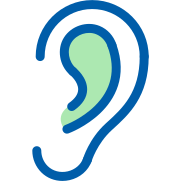
Our ears can be roughly divided into three parts:
The Outer ear collects sounds from our surroundings and is also called the Pinna. It is the part of the ear that we can see!
The Middle ear consists of the ear canal, eardrum, and the three little bones behind our eardrum.
The Inner ear is essentially our hearing sensory organ, also called the Cochlear. The cochlear is responsible for sensing the different sounds that we hear. Incidentally, our balance organ is also housed inside the cochlear.

Very briefly...
(1) Our Outer Ear or Pinna is responsible for "catching" and collecting sounds from the environment.
(2) The sound waves then travels down our ear canal, vibrate our eardurm which in turn, vibrate the three little bones attached to the eardrum.
(3) The three litte bones then responsible conduct the sound waves into our hearing organ (cochlear). Its is within the cochlear that a number of electrophysiological events take place and the sound vibrations are converted into electrical impulses which travel along our nerves delivering the message to our brains. It is interesting to note that our balance organ is also located within the cochlear.
(4) Our brains then look at the message from both of ears and process the information through a number of central centres (eg. our language centres) to deciper the content of the message - this is how we translate what we are hearing into meaningful language. Our hearing system is not only responsible for understanding speech, it is also reponsible for other functions, such as working out direction of sounds and work together with our other sensory systems to paint us a picture of the world around us.
what can go wrong...
Given that our hearing system is extremely complex and includes a number of different processes, not only in our ears, but also higher order processing by our brains, a breakdown anywhere along the pathway could potentially lead to us not understand what is being said.
To look at the ears by themselves, we can break down hearing loss into three general categories:
(1) Conductive Hearing Loss - is related primarily to the inability of the outer and middle ears to conduct the sound waves into the cochlear. ie. the passage way from the outside world into our hearing organ is blocked. The blockage cound be a physical blockage such as having compacted wax in the earcanal, or fluid in the middle ear as a result of an infection. It could also be a pressure blockage, such as during a cold and your ears become "blocked". In some cases, there may be a dysfunction of the three little bones in the ear or a hole in the eardrum which means that the middle ear system is not able to conduct the sounds as efficiently as it ought to. Most conductive losses are treated medically with antibiotics or surgery - your Audiologist will advise you on further medical referrals if your hearing loss is found to be conductive.
(2) Sensorineural Hearing Loss - commonly known as "nerve deafness", is a decrease in the cochlear's ability to "sense" sounds. The most common etiology that results in sensorineural hearing loss is the death of the tiny hairs that line the inside of the cochlear. When the little hairs break off, from noise exposure or as part of general decline, the cochlear becomes less sensitive to sounds. The cochlear is organized such that regions responsible for lower pitch sounds are more protected than those regions allocated to higher pitch sounds. Because of this, we tend to see hearing loss in the high pitch regions as a results of noise damage or part of general ageing. This type of hearing loss can only be aided by hearing instruments. The fact that we tend to see more high pitch nerve deafness has enormous implications on how people adapt to hearing aids. Read more about hearing rehabilitation in the coming pages.
(3) Mixed Hearing Loss - is a combination of the other two types of hearing losses.
The following pages give you an overview of what to expect in a hearing rehabilitation program - what it's like when you first get hearing aids. You can also read about some product solutions in later sections. |